Backlink Checker: How to Analyze and Build Quality Backlinks
Learn how to use a backlink checker to analyze your link profile, identify toxic backlinks, and build high-quality links that improve your SEO rankings.
A backlink checker is an essential SEO tool that analyzes the links pointing to your website from other domains. Backlinks remain one of Google's top three ranking factors — but not all backlinks are equal. This guide explains how to use a backlink checker effectively, what metrics matter most, and how to build a link profile that drives sustainable rankings.
What Is a Backlink Checker?
A backlink checker scans the web to find all external websites linking to your domain. It provides key metrics for each link: the linking domain's authority, the anchor text used, whether the link is dofollow or nofollow, and whether the link is potentially toxic. Understanding your backlink profile is the foundation of any serious SEO strategy.
Check Your Website's SEO Health
Run a free audit to see your on-page SEO, performance, and technical issues in seconds.
Run Your Free SEO Audit →Why Backlinks Still Matter in 2026
Google's algorithm has evolved significantly, but backlinks remain a core trust signal. A link from a reputable website tells Google that your content is credible and worth ranking. Studies consistently show that pages with more high-quality backlinks rank higher than pages with better on-page optimization but fewer links. The key word is quality — one link from a trusted authority site outweighs hundreds of links from low-quality directories.
Key Backlink Metrics to Analyze
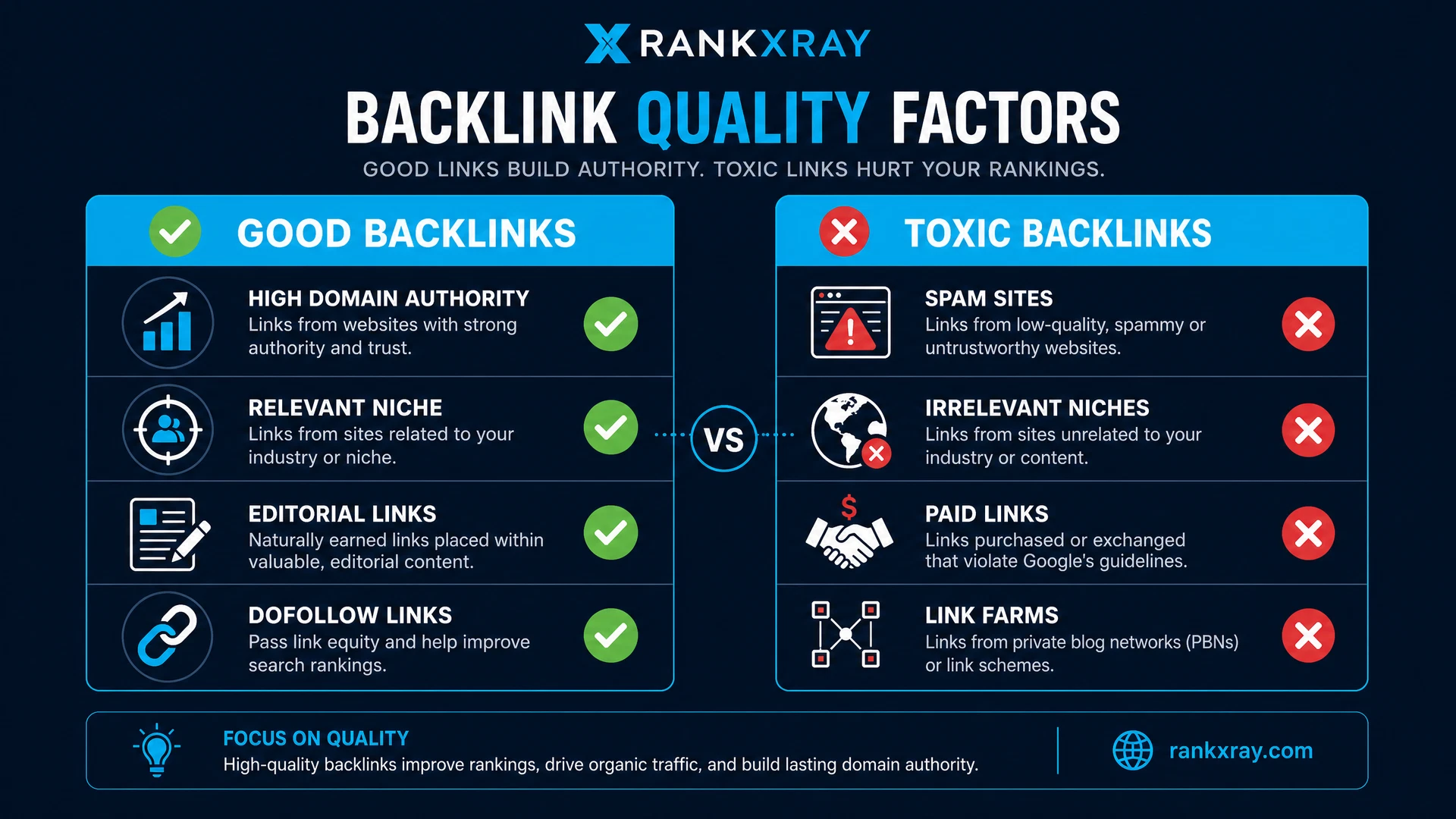
Domain Authority (DA) / Domain Rating (DR) — A score from 0–100 indicating how authoritative the linking domain is. Links from high-DA sites (60+) carry the most weight. Target: prioritize links from DA 40+ domains.
Anchor Text — The clickable text of the link. Diverse, natural anchor text (branded, generic, partial-match) signals organic link building. Over-optimized exact-match anchors can trigger Google penalties.
Dofollow vs. Nofollow — Dofollow links pass SEO value (link equity). Nofollow links do not pass equity but still drive referral traffic and diversify your profile. A healthy mix of both looks natural.
Link Relevance — Links from websites in your niche or industry carry more weight than links from unrelated sites. A backlink from a marketing blog to an SEO tool is more valuable than a link from a cooking website.
Toxic Score — Links from spammy, penalized, or irrelevant sites can hurt your rankings. A backlink checker identifies toxic links so you can disavow them in Google Search Console.
How to Analyze Your Backlink Profile
Step 1: Run a Backlink Audit — Use a backlink checker to pull your full link profile. Export the data and sort by domain authority to identify your strongest links.
Step 2: Identify Toxic Links — Filter for links with low authority scores, irrelevant domains, or spammy anchor text. These are candidates for disavowal.
Step 3: Analyze Anchor Text Distribution — Check your anchor text breakdown. If more than 20% of your anchors are exact-match keywords, your profile may look unnatural to Google.
Step 4: Compare to Competitors — Run a backlink check on your top-ranking competitors. Identify which domains link to them but not to you — these are your best link-building targets.
Step 5: Monitor New and Lost Links — Track links gained and lost over time. A sudden drop in backlinks can signal a penalty or a competitor poaching your links.
How to Build Quality Backlinks
Create Link-Worthy Content — Original research, comprehensive guides, and free tools naturally attract backlinks. This guide itself is an example — it provides value that other sites want to reference.
Guest Posting — Write articles for reputable blogs in your niche. Include a contextual link back to your site. Focus on quality over quantity — one guest post on a DA 60 site beats ten posts on DA 20 sites.
Broken Link Building — Find broken links on authoritative sites in your niche, then reach out to offer your content as a replacement. Tools like Ahrefs or Semrush can identify broken link opportunities.
Digital PR — Publish newsworthy content (studies, surveys, data reports) and pitch it to journalists and bloggers. A single mention in a major publication can generate dozens of high-authority backlinks.
Resource Page Link Building — Find "best resources" or "useful tools" pages in your niche and request inclusion. These pages exist specifically to link out to valuable content.
Reclaim Unlinked Mentions — Use Google Alerts or a backlink checker to find websites that mention your brand without linking to you. A simple outreach email asking them to add a link converts at a high rate.
Toxic Backlinks: How to Handle Them
Not every backlink helps your rankings. Links from penalized sites, link farms, or irrelevant directories can trigger Google's spam algorithms and hurt your rankings. Here is how to handle toxic links:
Step 1: Identify toxic links using a backlink checker that scores link quality. Flag any links from domains with spam scores above 60% or from clearly irrelevant niches.
Step 2: Attempt manual removal by contacting the webmaster of the linking site and requesting link removal. Document your outreach attempts.
Step 3: Disavow remaining toxic links using Google Search Console's Disavow Tool. Upload a disavow file listing the domains you want Google to ignore.
Use the disavow tool carefully — disavowing good links by mistake can hurt your rankings. Only disavow links you are confident are harmful.
Audit Your Full SEO Profile
RankXray checks your on-page SEO, technical health, and performance — free, instant, no sign-up required.
Start Free Audit →Backlink Building Timeline: What to Expect
Link building is a long-term strategy. New backlinks typically take 2–4 weeks to be crawled by Google and 1–3 months to show ranking impact. Consistency matters more than volume — building 5–10 quality links per month over 12 months outperforms a one-time burst of 100 low-quality links.
Track your progress monthly using a backlink checker. Monitor your domain authority trend, the number of referring domains, and your rankings for target keywords. A steady upward trend in referring domains almost always correlates with improved rankings over time.
Conclusion
A backlink checker is not just a diagnostic tool — it is a strategic asset. Regular backlink audits help you protect your rankings from toxic links, identify new link-building opportunities, and benchmark your progress against competitors. Combined with strong on-page SEO and technical optimization, a healthy backlink profile is one of the most reliable paths to sustainable first-page rankings.
Start by auditing your current SEO health with RankXray's free tool — then build your link strategy from a foundation of solid on-page fundamentals.